Why Feedback Doesn’t Happen – and How We’re Turning it into a Daily Habit
9 min read
Maria Törnroos
People Insights and Wellbeing Partner
As an organizational psychologist, I’ve seen that feedback is something every company struggles with at some point – and there’s no silver bullet for it. At the same time, feedback is one of the most powerful drivers of wellbeing and performance. Without it, people don’t know where they stand or how to improve. With continuous, clear feedback, they can learn faster and work more effectively together.
That’s why we want everyone at Metacore to feel empowered to actively give, ask for, and receive feedback – not just in performance reviews, but in the everyday moments that shape how we collaborate, solve problems, and move forward together. However, we’ve also seen that building a feedback culture isn’t always a simple and straightforward process. Here’s how we’ve approached this at Metacore, and started to turn feedback into a daily habit.
Why Feedback Doesn’t Happen
Metacore’s culture emphasizes high care and high performance, psychological safety and transparency – and feedback is an integral part of each of these areas. That’s why for years, we’ve included feedback training in our onboarding processes, developed feedback skills across the company, as well as offered personal coaching to anyone that has wanted further support with this topic.
As we grew, it became clear that feedback culture doesn’t scale automatically. New joiners don’t necessarily understand what “good feedback” looks like in practice and having it as an implicit part of our culture wasn’t enough – we needed to make it more explicit and more practical.
At the same time, asking for feedback wasn’t a natural habit for many and feedback tended to cluster around formal Growth & Development cycles instead of happening continuously in everyday work. We also saw that people don’t always recognize everyday feedback when they receive it, and that hesitation to give potentially uncomfortable feedback sometimes led to a lack of constructive input.
To address these challenges, we focused on four practical steps to make feedback a more natural part of day-to-day work.
Step 1: Defining Our Approach to Feedback
To start building a feedback culture at Metacore, we first needed to clarifyhow we think about feedback and explicitly define what “good” looks like.
We selected Radical Candor, a feedback model first developed by leadership coach Kim Scott, as our approach. Radical Candor is defined as feedback that is kind, clear, specific, and sincere. Here’s how that feedback approach aligns with our culture:
“The best feedback happens when honesty and care go hand in hand. At Metacore, we aim to challenge each other directly while showing we genuinely want the other person to aim high. This is how we build trust, support growth, and make sure everyone can perform at their best.”
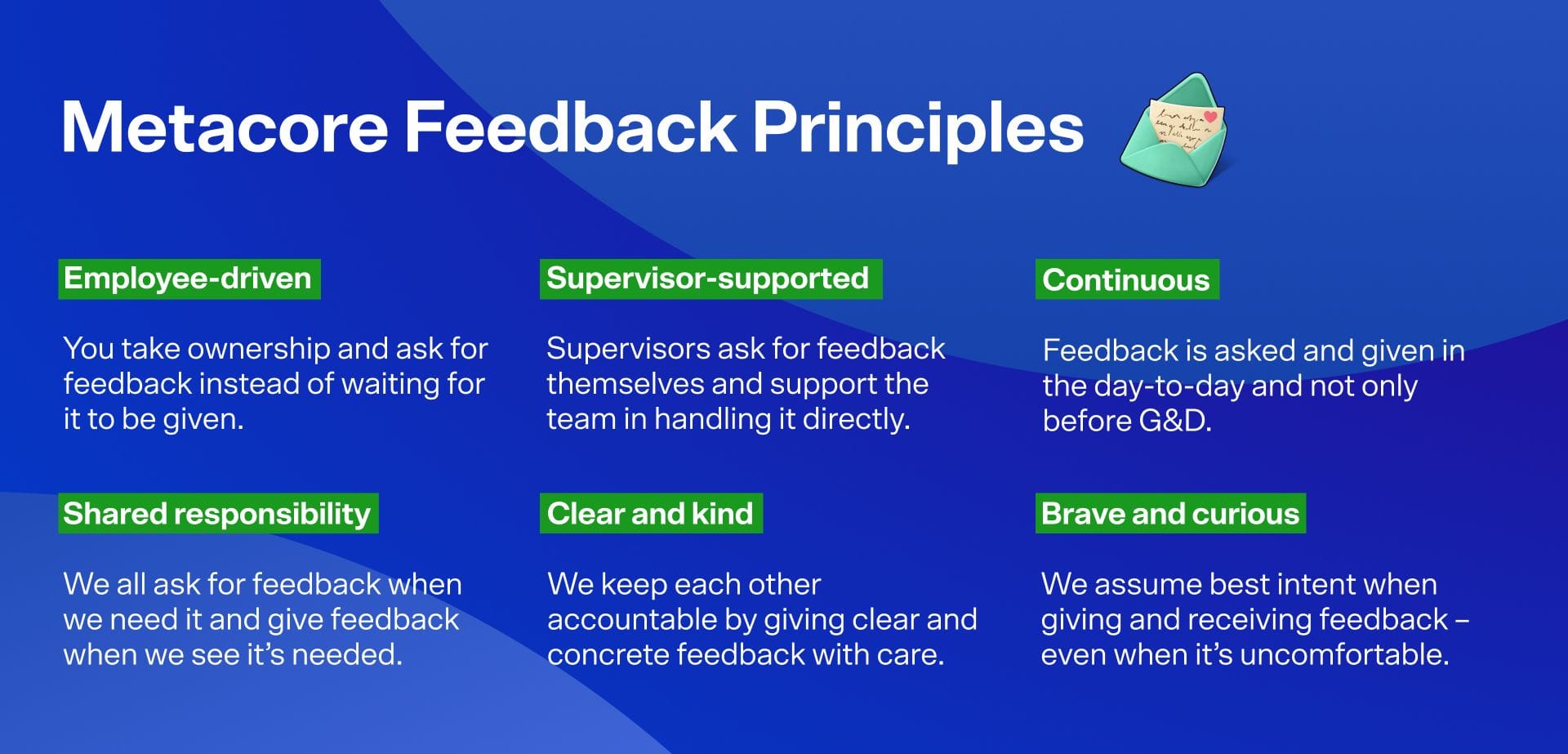
The most important shift we were aiming for was moving from waiting for feedback to be given, to asking for it directly and as a regular habit. To support this, we also defined more specific feedback principles as a team. Together, these form the basis of how and why we’re all expected to ask for and give feedback to others at Metacore:
Finally, to support how people approach feedback – especially constructive feedback – we’ve used simple frameworks such as the Growth vs. Fixed Mindset model to describe different reactions to feedback. This wasn’t about teaching a specific theory, but about making feedback behavior easier to understand in practice.
The goal here is to reframe feedback from something uncomfortable and negative into something that helps us grow through very practical examples such as the ones below:
Feedback is criticism → Feedback helps me improve
I avoid situations where I might be wrong → I ask for feedback to learn
I only seek feedback that confirms what I already know → I’m open to being challenged
If I struggle, I assume I’m not good at it → If something doesn’t work, I try a different approach
Step 2: Reinforcing Feedback as a Continuous Habit, Not a Process
We recognized early on that feedback needs to happen in small, everyday moments, not through burdensome processes. We definitely didn’t want to add extra or unnecessary layers of admin for teams. This meant we needed to shift focus from tools and cycles to behaviors and habits.
We’re currently helping team members recognize moments in their work where feedback would help, and then start embedding feedback into their own team rituals. So, for example, once something is completed – we’ve finished a project, milestone, or presentation – team members should always ask what worked, and where we can improve the next time. Likewise, during a transition – we’re moving to a new phase or switching direction – teams should pause, ask for feedback to clarify what we’re keeping and what we’re changing.
This work with teams is still ongoing, but a simple “IF/WHEN” setup has been an easy way for teams to approach building and embedding feedback rituals into their daily work. For example:
IF something is completed → THEN ask for feedback
IF you have a first version or draft → THEN share it and ask for input
IF we have a recurring team meeting → THEN we include one short feedback moment “Anything we should continue or change?”
Step 3: Offering Practical Tools to Develop Feedback Skills
To make sure that individual team members feel comfortable and supported in giving and asking for feedback, we’ve also provided practical guidance on the topic in our company intranet. This includes concrete script examples to ask for, give, receive and act on feedback, as well as examples of how to make feedback specific, clear, kind and sincere – including example AI prompts to help team members structure feedback requests. There’s also contextual guidance on when to give face to face feedback, when to use the formal feedback tool, and when a simple Slack message is enough.
Because we want to ensure that we don’t just ask for feedback but that it actively contributes to long-term growth at Metacore, we’ve created materials to support team members in using feedback in their self-reflection and growth plans. This includes practical questions to help identify patterns: What feedback came up more than once? What feedback surprised you? What feedback confirms something you already know?
The questions also help reflect and zoom in on concrete areas of improvement: What specific behavior do you want to improve? In what situations does this show up? What would “better” look like in practice?
The goal is to help turn feedback into concrete, actionable development.
Step 4: Keeping Feedback Top of Mind
Finally, we want to make sure that the best feedback practices make it off the company intranet and become routine at Metacore. That’s why we’ve introduced monthly feedback refreshers where we’ve reinforced that feedback is a part of everyday work, and something we all need and deserve to grow as individuals, teams and a company. To make the impact of this work more visible and tangible, we’ve had members from our leadership team, company operations and game teams share real examples and success stories about asking, giving, and acting on feedback at our company-wide Friday Coffees, which have been really motivating moments for many.
Leaders play a key role in setting the example and making feedback a daily habit. This means asking for and acting on feedback themselves, but also holding their teams accountable. Without their leadership, it becomes harder to build and instill a genuine feedback culture.
…and Repeat:
If there’s one thing I’ve learned in my years as an organizational psychologist, it’s that a strong feedback culture doesn’t develop overnight – it takes deliberate action, repetition and patience.
We’re not aiming to be “done” – we’re aiming to see progress. This could mean more feedback being asked and given, improvements in our feedback-related survey questions, or more real examples of feedback in action.
While success in this area is not always easy to measure, progress in the things that matter to us at Metacore – such as making feedback continuous and ensuring that people get constructive feedback to grow – helps us know we’re on the right track. But, ultimately, developing a feedback culture is like brushing your teeth – it only works when you do it consistently, not just when it feels important.
Maria Törnroos is a work and organizational psychologist (PhD) and People Insights and Wellbeing Partner at Metacore. She is a published author who has worked extensively on topics such as wellbeing, self-leadership, and feedback, and works with people insights to support decision-making.